Research
Ultrasound can reach deep into the body without cutting it open, and it carries mechanical force. We study how that force acts on soft materials at the microscale, and we use what we learn to build therapies and devices that work without incisions.
Therapeutic cavitation
Acoustic cavitation involves the response of gas microbubbles under ultrasound. Based on the intensity, they can undergo stable radial oscillations for a prolonged time, or show inertial growth and collapse.
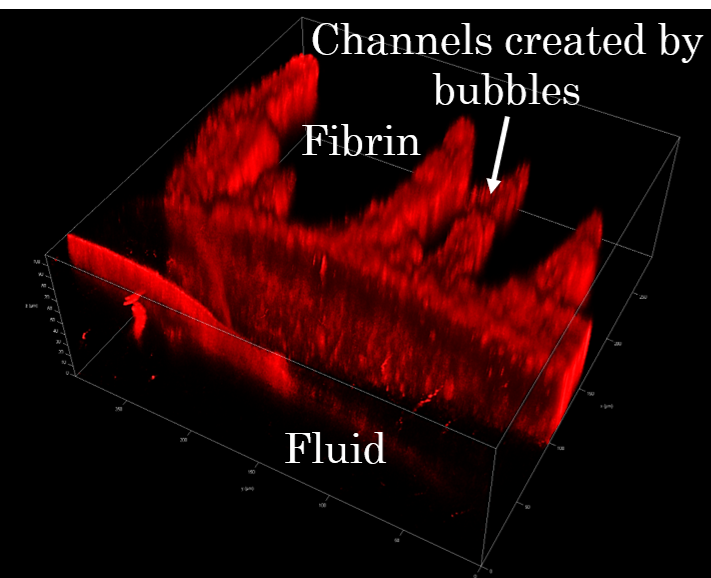
Our recent work shows bubble oscillations can be used to remodel fibrin networks, typically found in blood clots and wounds. We explore the underlying mechanism and show that these bubbles could increase the matrix transport properties of an otherwise impenetrable network, by creating deep microchannels into the network.
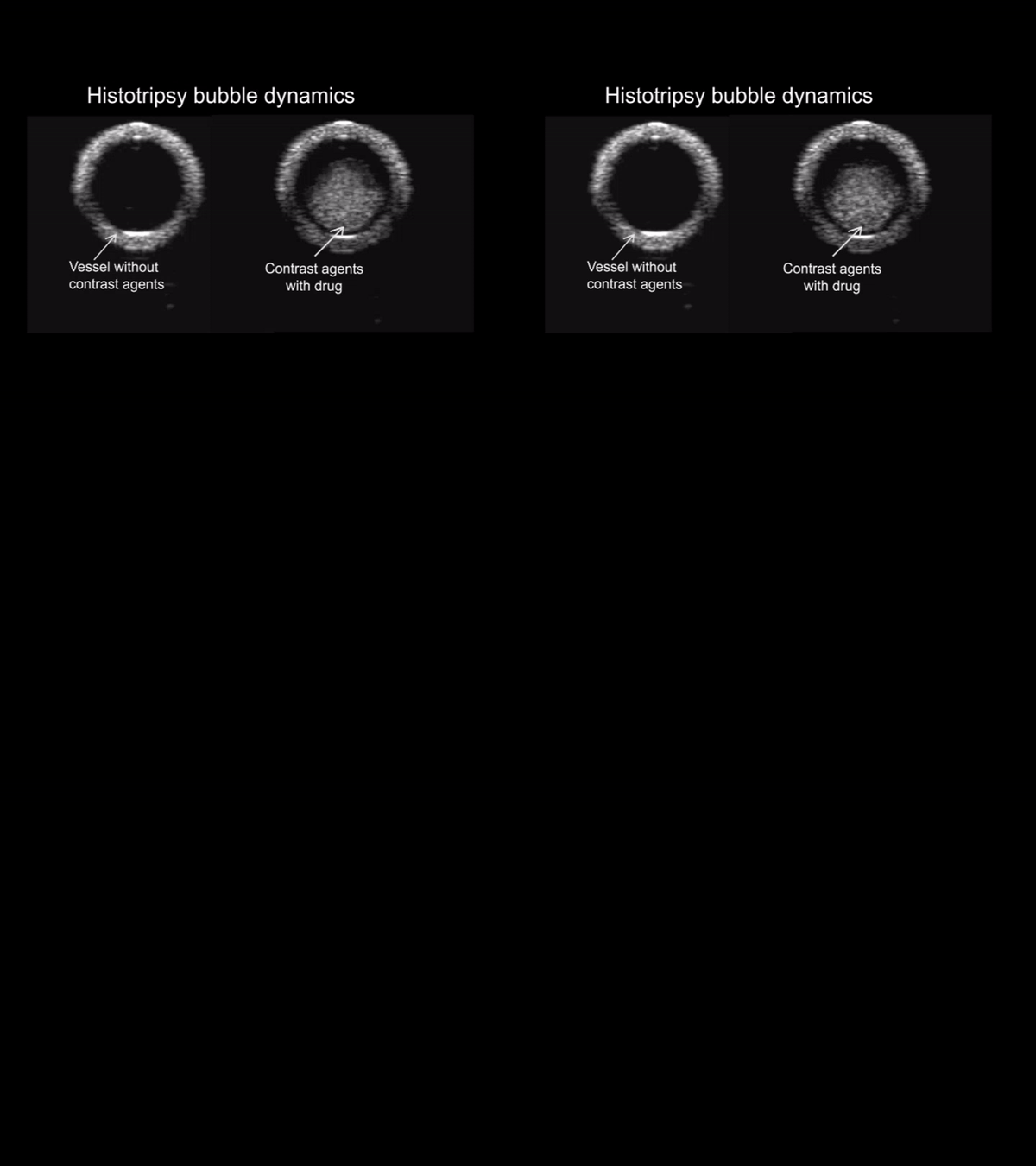
Histotripsy uses the mechanical activity of bubble clouds to break down tissue without depositing heat. In venous thrombosis, we found that combining histotripsy with catheter-directed thrombolysis achieved equivalent fibrinolysis at more than a tenfold reduction in the dose of rt-PA (Hendley et al., PLoS One, 2022). That matters because bleeding risk scales with lytic dose. Related work characterised why some thrombi resist lytic therapy at all (Hendley et al., Scientific Reports, 2021), and how ultrasound-triggered echogenic liposomes change the behavior of the bubble cloud itself (Bhargava et al., Physics in Medicine & Biology, 2022).
Mechanobiology of acoustic forces
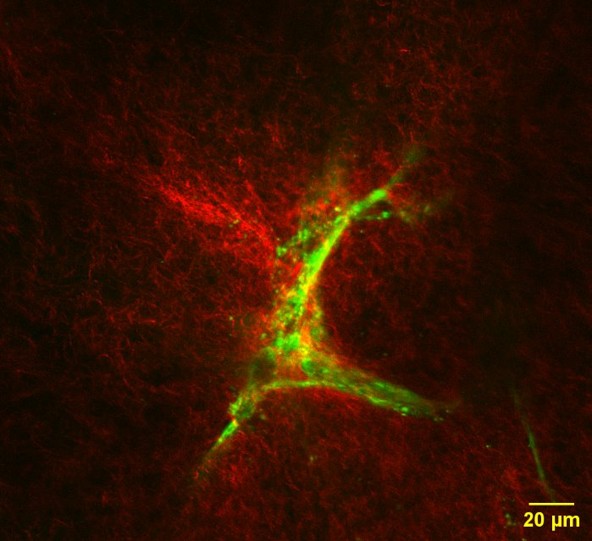
Cells read mechanical cues from their surroundings and change their behavior accordingly. Ultrasound can deliver those cues non-invasively, at depth, and with spatial precision that few other stimuli offer.
Using lab-on-chip platforms, we apply controlled acoustic forces to cells and measure how their response changes. The aim is to alter cell behavior predictably and controllably, rather than as a side effect of treatment.
Acoustically responsive materials and microsystems
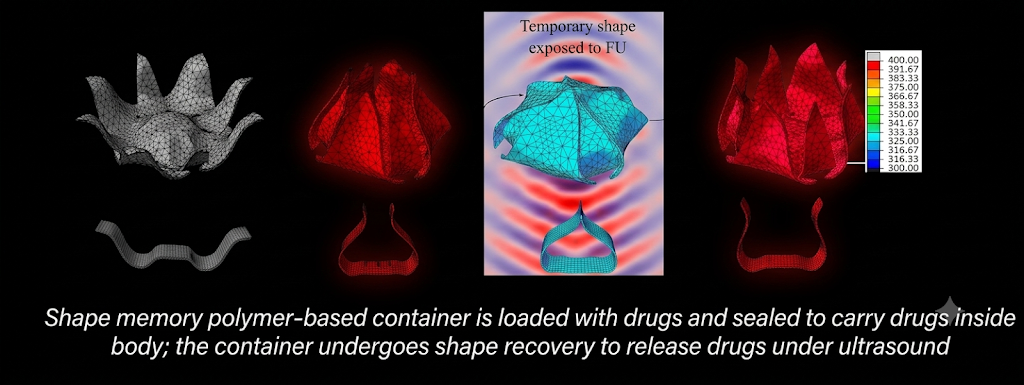
Some materials can be given a task and then driven from outside the body by sound alone, with no wires, no batteries and no incision. We design them, model them and test them.
This has included shape-memory polymers actuated by focused ultrasound as drug-delivery containers, piezoelectric Janus microparticles that stimulate neurons wirelessly under low-intensity focused ultrasound (Han et al., Nature Communications, 2024), hierarchical nanostructures that can be acoustically trapped and steered inside flowing fluid (Kim et al., Advanced Materials, 2024), and the acoustic-electroelastic modeling behind ultrasound power transfer.
The method is consistent across these projects: understand the wave-material interaction first and optimize it through modeling, then build prototypes and test them in in vitro and in vivo settings that mimic the intended application.